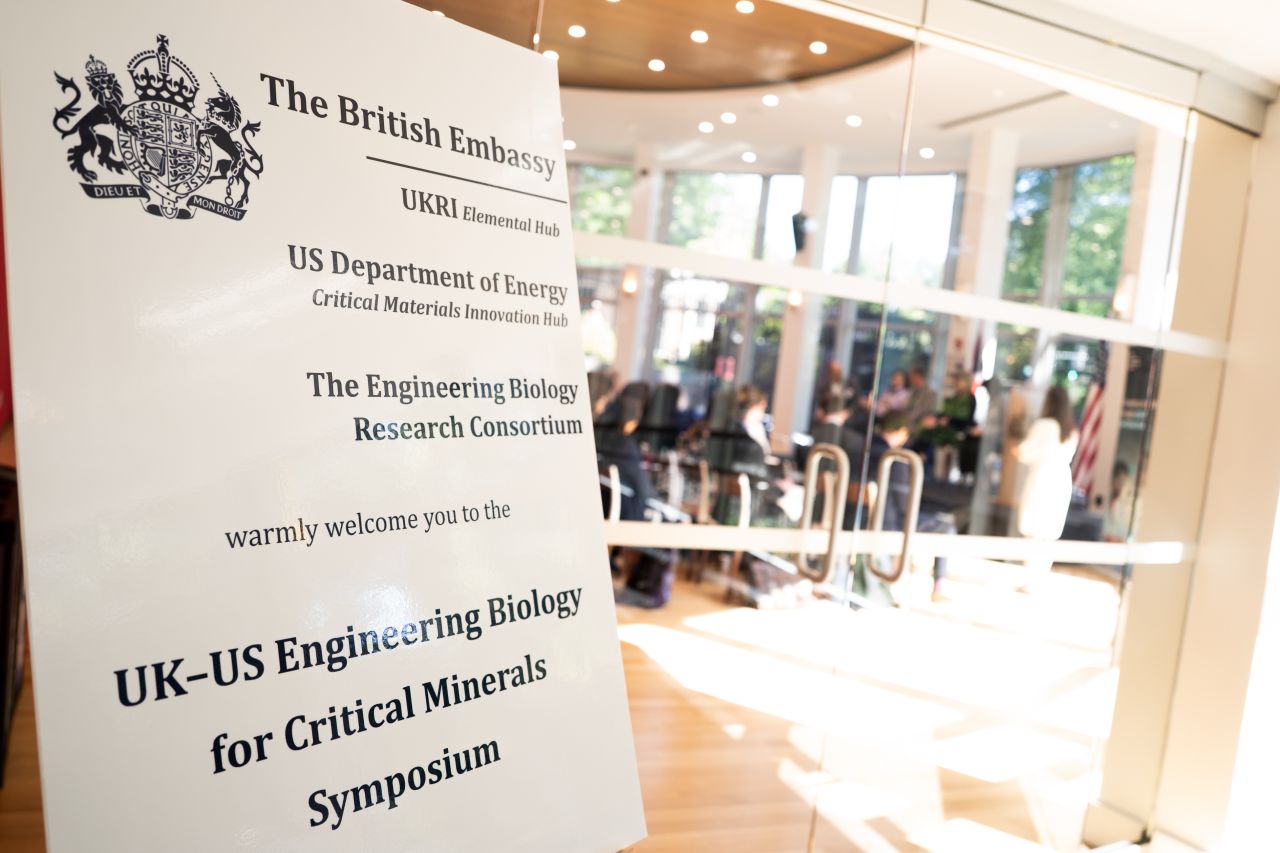
Critical minerals are essential to the clean energy transition, advanced manufacturing and emerging technologies, yet securing reliable and sustainable supplies has become an increasing economic, environmental and geopolitical challenge. A new report from the UK-US Symposium on Engineering Biology for Critical Minerals highlights how engineering biology could help address these challenges while strengthening collaboration between the United Kingdom and United States.
The report identifies significant opportunities for engineering biology to support more resilient, sustainable and secure critical mineral supply chains through innovative approaches to resource recovery, recycling, remediation and mineral processing. It also sets out priorities for future UK-US collaboration in research, innovation and technology development.
The symposium, held at the British Embassy in Washington DC on 4th June 2026, brought together researchers, industry leaders, funders, policymakers and government representatives from across the United Kingdom and United States. Organised by the UK Science and Technology Network, Elemental Engineering Biology Mission Hub, US Department of Energy Critical Materials Innovation Hub and the Engineering Biology Research Consortium (EBRC), the event explored how engineering biology could help address critical mineral challenges ranging from resource recovery and recycling to waste remediation and sustainable processing.
” Critical minerals are essential to the technologies shaping our future, yet securing sustainable and resilient supplies remains a major global challenge. Engineering biology offers exciting opportunities to transform how we recover, process and recycle these vital resources. This symposium has demonstrated the power of UK–US collaboration in bringing together scientific expertise, industrial innovation and policy leadership. By combining our strengths, we have a real opportunity to establish engineering biology as a key enabling technology for more secure, circular and sustainable critical mineral supply chains, while driving a new generation of transatlantic research partnerships and innovation.”
Professor Martin Warren, Chair and Principal Investigator of the Elemental Engineering Biology Mission Hub.
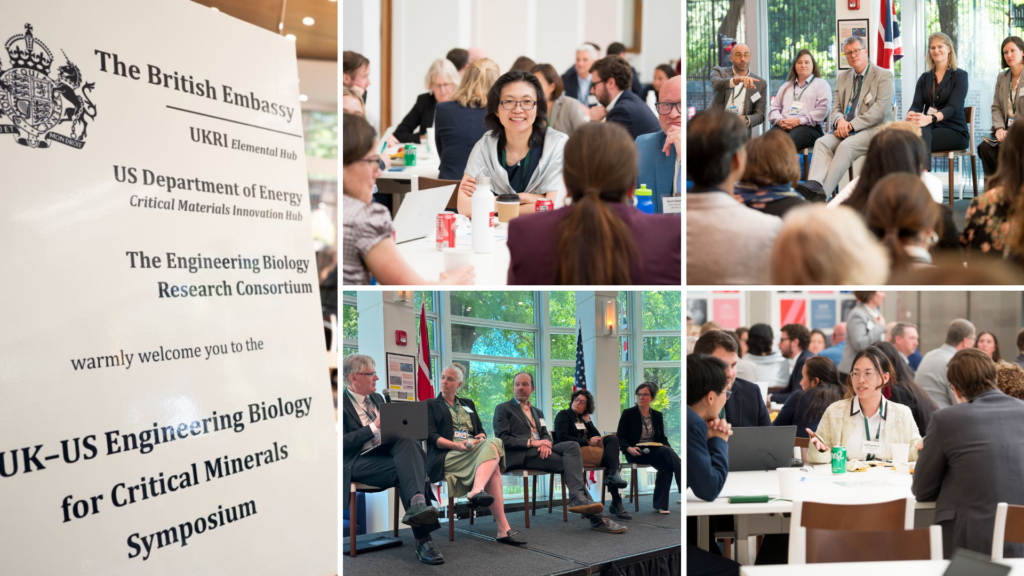
Photos from the UK-US Symposium on Engineering Biology for Critical Minerals, held at the British Embassy in Washington DC on 4th June 2026.
The report identifies engineering biology as an emerging tool that could help improve resilience through innovative approaches such as bioleaching, biosorption and biomineralisation. Some of the most promising near-term applications for engineering biology identified lie in water treatment, recovery of materials from waste streams and electronic waste, remediation of legacy mine sites, and the processing of low-grade ores. Participants emphasised that successful deployment will depend on demonstrating clear economic and environmental benefits, addressing scale-up challenges and building confidence among industry and wider stakeholders.
“The symposium was candid about the challenges of making biomining work in practice, from scaling processes for variable feedstocks to building shared, usable datasets and earning the trust of industry and communities. The UK and US are better placed to address these challenges together. Progress will require coordinated research and funding, easier sharing of samples and data, and clear support for engineering biology in both countries’ critical minerals strategies. EBRC looks forward to working across the research, industry and policy communities to turn these priorities into coordinated UK-US action.”
Garrett Dunlap, PhD, Director of Policy and Partnerships at the Engineering Biology Research Consortium (EBRC).
A central theme throughout the discussions was the value of trusted international partnerships. Participants highlighted the complementary strengths of the UK and US research and innovation ecosystems, with opportunities to combine expertise, infrastructure, funding mechanisms and industrial capabilities to accelerate technology development and deployment.
The report notes that collaboration between researchers, industry, funders and policymakers will be essential to realise the potential of engineering biology in critical mineral applications. Participants also stressed the importance of focusing efforts on areas where biological approaches can deliver clear advantages and tangible environmental and economic benefits.
 Participants identified several priorities for future action, including strengthening UK-US research partnerships, improving access to shared datasets and materials, building links between academic and industrial communities, and exploring opportunities for coordinated research and innovation funding. The report is intended to provide a foundation for future collaboration in this rapidly developing field.
As countries seek to secure access to the materials needed for clean energy, advanced manufacturing and emerging technologies, the findings underscore the growing importance of international collaboration in developing innovative and sustainable approaches to critical mineral production, recovery and reuse.
Partners are now exploring opportunities to build on the symposium through future collaborative research activities, knowledge exchange initiatives and funding opportunities
Access the Report
The full report, UKUS_Symposium_Engineering_Biology_Critical_Minerals_2026, is now available to download. It captures the key discussions, opportunities and recommendations emerging from the symposium and provides a roadmap for future UK-US collaboration at the intersection of engineering biology and critical minerals.
Editor’s Notes
- The UK-US Symposium on Engineering Biology for Critical Minerals was held at the British Embassy in Washington DC on 4th June 2026.
- The symposium was jointly organised by the UK Science and Technology Network, Elemental Engineering Biology Mission Hub, US Department of Energy Critical Materials Innovation Hub and the Engineering Biology Research Consortium (EBRC).
- The event brought together stakeholders from academia, industry, government and funding organisations across the UK and US to explore opportunities for engineering biology to contribute to critical mineral supply chains.