
Today we shine a spotlight on Jhuma Sadhukhan, Professor of Environmental, Energy and Chemical Engineering at University of Surrey. Jhuma is an ELEMENTAL Hub Co-I for work package 6, where her expertise in the life cycle assessment (LCA) and technoeconomic analysis (TEA) contributes to optimisation and upscaling of Engineering Biology Systems across all Hub work packages.
Please will you introduce yourself and describe your specific role or focus within the ELEMENTAL Hub.
I’m Jhuma Sadhukhan, Professor at the University of Surrey and a Fellow of the Royal Society of Chemistry (FRSC), a Fellow of the Institution of Chemical Engineers (FIChemE), a Chartered Engineer (CEng) and a Chartered Scientist (CSci). My focus is on whole-systems analysis, life cycle assessment (LCA), techno-economic analysis (TEA), and process-systems design that connects laboratory engineering biology to scalable, industrially-deployable, circular bioprocesses.
I Co-Lead ELEMENTAL Hub. I lead WP6.4: LCA and TEA strands of the ELEMENTAL hub, applied to the other technical work packages.
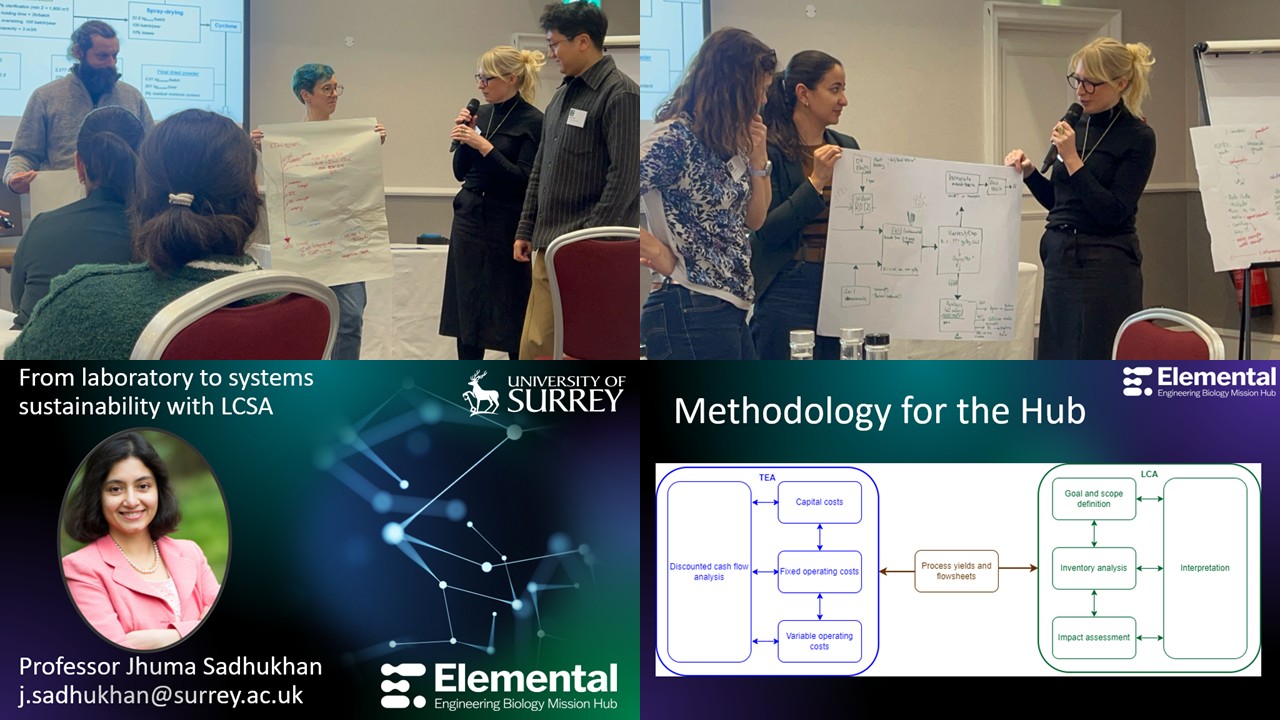
The ‘Methodology for the Hub’ segment is from Sadhukhan, J., Hu, X., Sen, R., Smith, J.B., Dunbar, K.L., Bywater, A., Yoo, C.G., Wie, J.J. and Ragauskas, A.J., 2026. PHA Biocomposites from Lignocellulose: Scalability and Sustainability Analyses through Dynamic Simulation, LCA, and TEA. Green Chemistry, 28, 9369-9387. DOI: 10.1039/D6GC00337K
What first inspired you to work in environmental biotechnology or metal bioprocessing?
I have been working on environmental biotechnology since 2004, with my first lectureship at the University of Manchester. My motivation was to apply my Chemical Engineering, in particular, process integration skills that I gained during my education and industrial experience with KBR and Technip, to develop cost-competitive biorefineries. The energy cost is the determining factor for the economic viability of biorefineries and we demonstrated that biorefineries, producing high-value functional products, can be profitable when process integration is applied for in-process energy recovery and generation https://doi.org/10.1016/j.ces.2007.09.039. Later, I with my two PhD graduates, published the only authored textbook in the field: https://onlinelibrary.wiley.com/doi/book/10.1002/9781118698129. Following this, I got the invitation to collaborate on the NERC Resource Recovery from Waste project (2014) on metal recoveries to translate laboratory research into industrial-scale sustainable manufacturing systems by the application of LCA, TEA and process integration.
Can you briefly describe your current research and how it contributes to the Hub’s mission of sustainable metal recovery, circular economy, or biosensing?
In the ELEMETAL Hub, I contribute in three connected ways: first, by providing the LCA, TEA, and process-systems frameworks that quantify when a bio-based metal recovery route is genuinely more sustainable than incumbent hydrometallurgy; second, by linking biosensing and bioprocessing into closed-loop designs where in-situ monitoring informs adaptive recovery; and third, by translating laboratory-scale engineering biology into mass- and energy-integrated process blueprints that industry partners can act on. The work sits deliberately at the interface between engineering biology and the deployment route.
What excites you most about working in the field of engineering biology for environmental impact?
The pace at which a credible laboratory result can now travel toward an industrial decision. A decade ago, an engineering-biology breakthrough would sit in a journal for years before anyone modelled its real-world footprint or its economics. Today, with co-located bioprocess, digital-twin, and sustainability-assessment capability, that gap is closing. I, for example, also co-direct the UK-wide Carbon-Loop Sustainable Biomanufacturing Hub (C-Loop) (https://gtr.ukri.org/projects?ref=UKRI1891) and worldwide Global Centre for Sustainable Bioproducts (GCSB) (https://globalcsb.sites.utk.edu/principal-investigators/). What excites me is being able to ask, almost in the same week as a wet-lab result, whether it actually delivers carbon, cost, and circularity benefits at scale, and to feed that answer back into the next experiment. Engineering biology and engineering sustainability genuinely converge at that point.
How has being part of the ELEMENTAL Hub influenced your work or expanded your horizons?
Working across ELEMENTAL alongside the C-Loop Advanced Manufacturing Hub, the Global Centre for Sustainable Bioproducts, the Flue2Chem consortium, and the BBSRC Strategic Advisory Panel has fundamentally changed how I frame research questions. The mission-hub model forces a discipline I don’t think I would have arrived at alone: every research idea is pressure-tested against industrial adaptation, policy alignment, and cross-sector relevance from the outset. It has also given my group access to instrumentation, microbial strain libraries, and pilot facilities far beyond any single institution, and, most importantly, to early-career researchers and PIs whose disciplinary starting points are very different from mine. That cross-pollination is where the most interesting work tends to begin.
Are there any standout collaborations or opportunities you’ve experienced through the Hub?
A few stand out. A visit to the Natural History Museum is a truly eye-opening experience. Going behind the scenes revealed world-class facilities: immaculate laboratories and some of the UK’s most advanced analytical capabilities in mineralogy and life sciences. Grateful to the Elemental | Engineering Biology Hub for bringing together such complementary and leading expertise. Ongoing Collaborations with NHM, The University of Manchester and UEA have been rewarding.
Could you share a recent achievement or milestone, perhaps a publication, presentation, tool development, or outreach, that you’re proud to highlight?
I co-authored a collaborative Nature Chemistry publication: Nature Chemistry, 18, 535-543. https://www.nature.com/articles/s41557-025-02052-y. My Innovate UK Flue2Chem project with fifteen industries is the winner of the UK Net Zero Industry Outstanding Project Award at COP30: https://net-zero-industries-mission.net/national-winners-of-the-2025-net-zero-industries-award-unveiled-at-cop30/ I was the main process integration/intensification, LCA/TEA researcher of Flue2Chem, turning CO2 into high-value surfactants: https://doi.org/10.1016/j.jcou.2024.103013; https://clovecircle.com/standalone/flue2chem-lca-tea.html.
As a BBSRC Strategic Advisory Panel member (2020-2026), I help shape the UK’s Engineering Biology Mission for the circular net-zero bioeconomy. I was awarded the University of Surrey Vice-Chancellor’s Awards in two consecutive years, Researcher of the Year (2024) and Public and Community Engagement (2025), the first such back-to-back recognition in the fourteen-year history of the awards, reflecting development that has reshaped thinking on industrial decarbonisation and delivered demonstrable societal and economic impact. A patent GB2517320.4 (filed), on which I’m a co-inventor, covers Lithium-ion battery recycling.
What challenges have you encountered in your work, and how have you overcome them?
The persistent challenge in this field is the gap between a promising laboratory result and a genuinely deployable industrial process. Bioprocesses are sensitive to feedstock variability and scale-up rarely behaves linearly. My approach has been to embed LCA, TEA, and process integration from the very first design choices by working closely with the experimental groups and industrial collaborators; many of these surprises surface early enough to be designed out rather than discovered late.
What’s one key insight you’ve gained through your research or participation in the Hub?
That circularity is, fundamentally, a systems property, not a feature of any single organism, catalyst, or unit operation. A microbe that recovers a metal elegantly in isolation can still sit inside an overall process that is more carbon-intensive than the linear route it was meant to displace. The mission-hub environment requires for me that the unit of analysis has to be the whole system: feedstock, bioprocess, downstream recovery, energy and water integration, end-of-life, and the policy and market context the technology will land in. Engineering biology delivers its environmental promise only when that wider system is designed with the same care as the biology itself.
What drives you in your day-to-day research?
The combination of two things: working with early-career researchers: I’ve had the privilege of supervising more than 40 postdocs and 25 PhD completions to date and the sense that the questions we work on genuinely matter to the climate and resource challenges of the next two decades. On any given day, those two motivations reinforce each other. A good supervision conversation often reframes a research problem; a hard research problem often becomes the most useful teaching material.
What are your hopes or predictions for the future of the ELEMENTAL Hub or the field of environmental biotechnology?
I hope that ELEMENTAL becomes a model for how engineering biology can be coupled, end to end, to circular-economy outcomes that are measurable, certifiable, and bankable. Specifically, I expect the next five years to see bio-based metal recovery move from compelling demonstrations into routinely-deployed components of industrial circular value chains, supported by the kind of integrated digital, sustainability, and process infrastructure the Hub is putting in place. More broadly, I think environmental biotechnology is approaching the point where it stops being framed as an alternative to incumbent industries and starts being recognised as the default route for any new sustainable manufacturing build.
Please share one fun or unexpected thing about yourself that few people know.
I have several hobbies. First of all, I care for a large family with human and non-human children. I have six adopted non-human babies. They occupy most of my time outside work. I love painting, photography and gardening. Bedtime reading is my favourite hobby. My boys and husband say that I am a good cook, too.
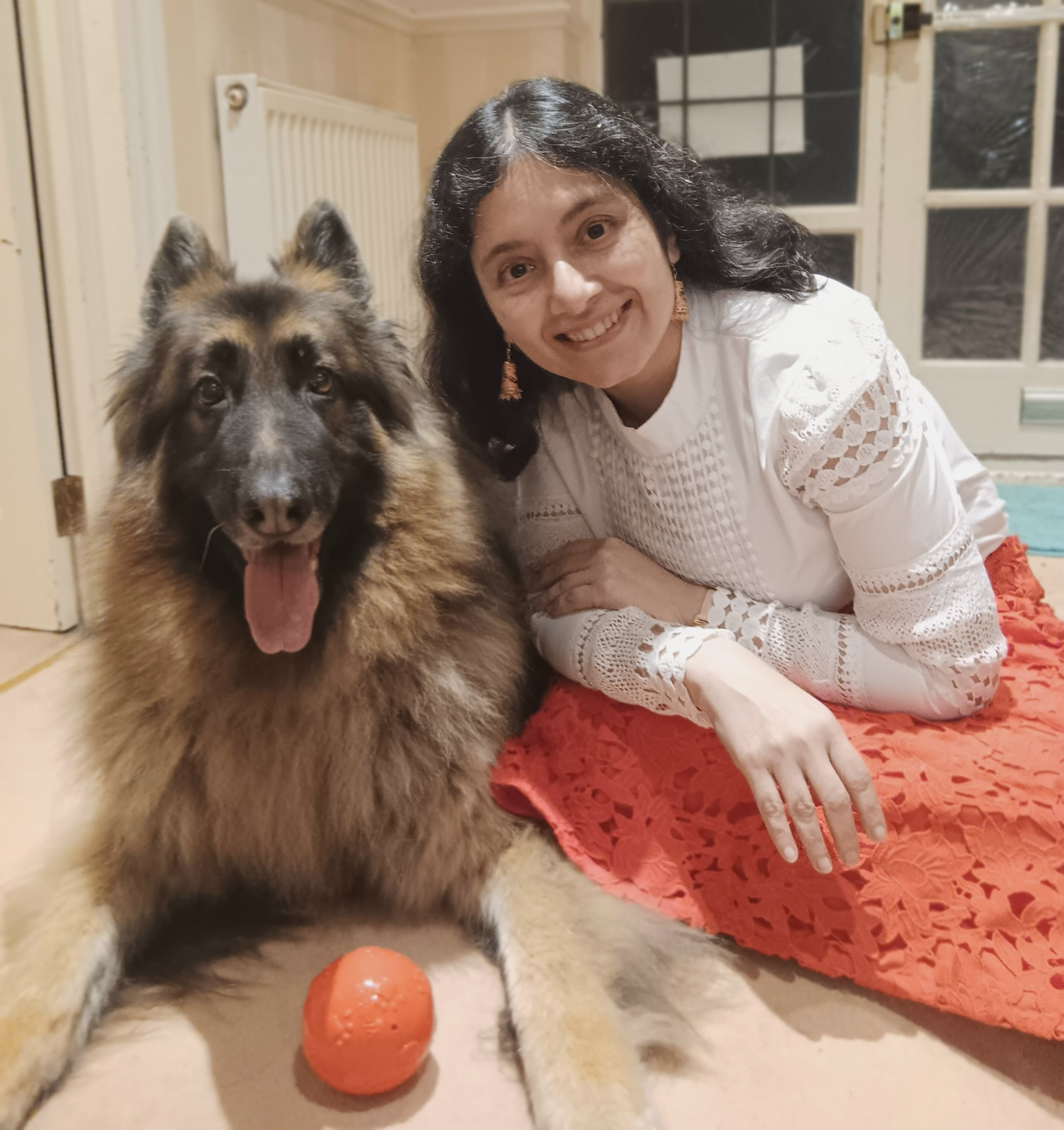
Jhuma with her non-human child, Simba, a 10-year old GSD, an absolutely friendly gentle giant.
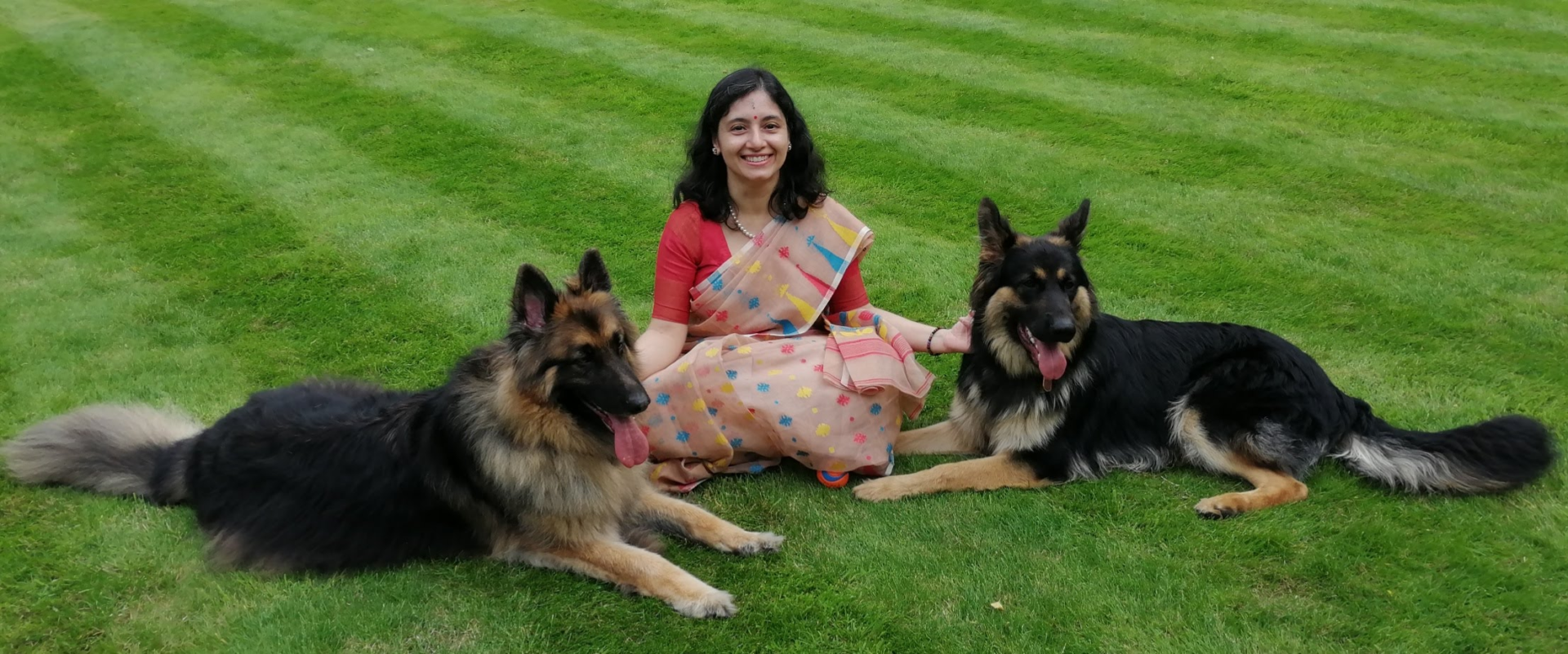
Jhuma, Simba, and the neighbour’s dog Rico, a 5-year old GSD.
If your work had a “superpower,” what would it be and why?
If I had “superpower”, I could look at a single laboratory experiment and instantly see its carbon, cost, and circularity footprint at an industrial scale. The superpower I’d choose is the one that lets us see whether a discovery genuinely makes the system more sustainable.
Jhuma Sadhukhan’s work highlights how systems thinking, sustainability assessment, and engineering biology can come together to accelerate the transition from laboratory innovation to real-world industrial impact. Through her work within the Elemental Hub, she is helping to ensure that future bio-based technologies are not only scientifically groundbreaking, but also scalable, economically viable, and capable of delivering lasting environmental benefits.
If you’re interested in collaborating with Jhuma or would like to learn more about her work, click here to get in touch and explore her research.