Jump to accessibility statement Jump to content

ELEMENTAL

Stay informed about the latest activities and opportunities within the ELEMENTAL Engineering Biology Mission Hub. Our events calendar features upcoming conferences, workshops, and training sessions designed to foster collaboration and innovation in the field of environmental metal processing. Explore past events to see how our community is advancing sustainable solutions through bioengineering.

Upcoming Events

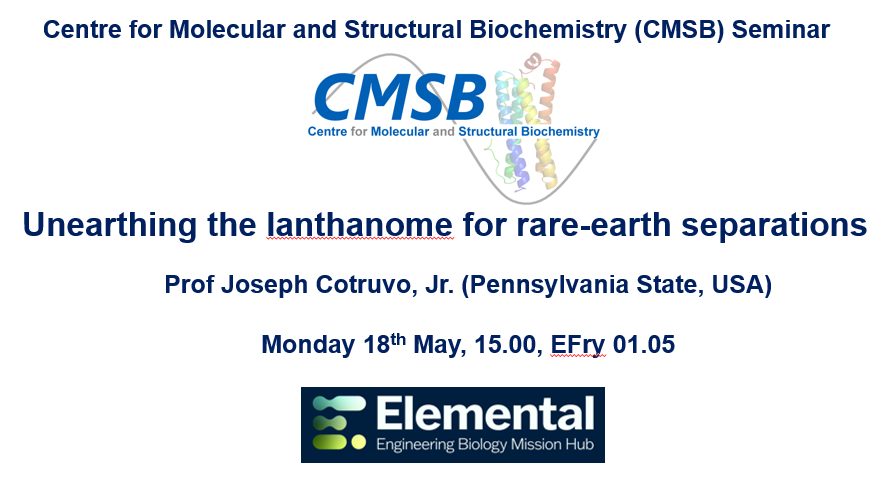
Abstract: The essential biological role of lanthanides has been appreciated for just 15 years, since the discovery that certain lanthanides are specifically incorporated into a methanol dehydrogenase enzyme in methylotrophic bacteria. Rare earth elements, which include the lanthanides, are considered by the UK and US governments to be especially critical minerals for technology and national security, in part because they are among the most difficult metals to separate and purify from one another. In this talk, I will describe our efforts to understand how bacteria selectively uptake, sort, and traffic lanthanides, using novel biomolecules that constitute the “lanthanome.” Our studies have revealed insights into how biology employs all levels of protein structure, primary to quaternary, to achieve selectivity for lanthanides (and actinides) over the rest of the periodic table, as well as within the lanthanide series. I will also show how we have leveraged this understanding to develop biomolecular technologies for recovery and separation of lanthanides, which are being explored commercially to help ensure a sustainable supply of these critical metals.

Meet the speaker

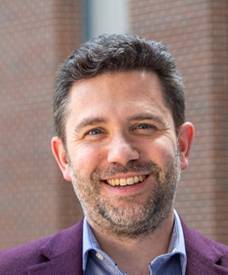
Joseph Cotruvo, Jr. is a Professor of Chemistry at the Pennsylvania State University. He graduated with an A.B. from Princeton University, and he received his Ph.D. with JoAnne Stubbe at MIT. After postdoctoral work with Chris Chang at UC Berkeley, he began his independent career in 2016. His laboratory works to understand how biological systems achieve selective recognition of metal ions and to develop biotechnologies for sensing, recovery, and separation of valuable metal ions, especially rare earth elements. His laboratory’s work has been honoured by several awards, including a Sloan Research Fellowship, the Eli Lilly Award in Biological Chemistry (American Chemical Society), and the Society of Biological Inorganic Chemistry (SBIC) Early Career Award, and he has been named a finalist for the Blavatnik National Awards for Young Scientists twice.

Anyone interested in attending should email the elemental mailbox for more details. elementalmetalhub@kent.ac.uk

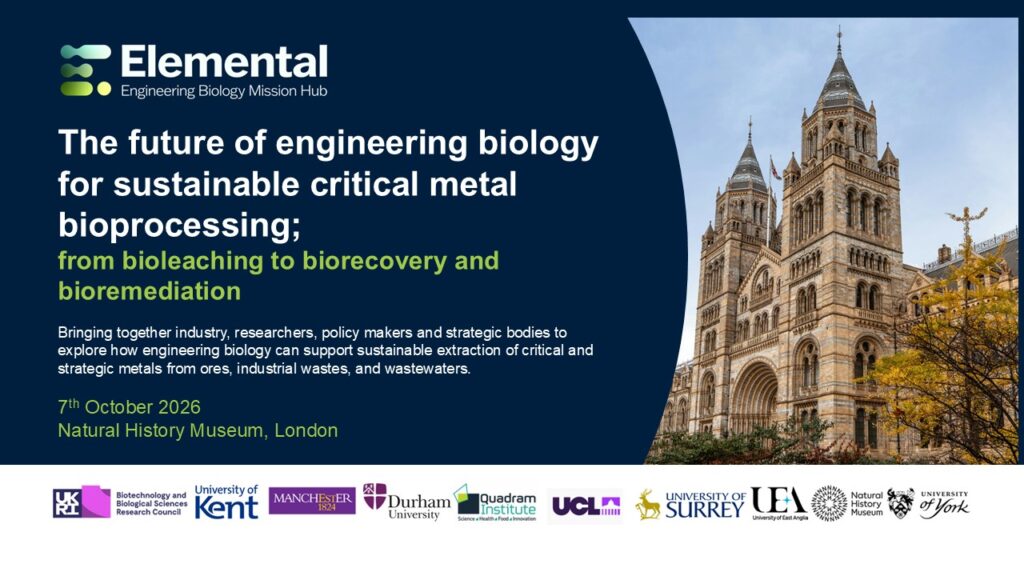
Please note this is now a hybrid event. Join us at the Natural History Museum for a lecture by Professor Paul A. Schroeder exploring the history and global significance of the Georgia kaolin industry and its links to the development of high-tech materials. Drawing on decades of research, he will discuss how kaolin mining may also offer new opportunities to recover rare earth elements, critical minerals essential for modern technologies. This talk will highlight emerging pathways to strengthen sustainable supply chains for advanced materials. 

Bios: Professor. Paul A. Schroeder. https://geology.uga.edu/directory/people/paul-schroeder 

Professor. Paul A. Schroeder is a clay scientist with nearly 45 years of research spanning crystal chemistry and mineral reactions on the Earth’s surface and below. His work extends from laboratory spectroscopy and isotope geochemistry to field studies of soil formation, hydrothermal alteration in volcanoes, kaolin clays, and planetary materials, including Martian regolith. He has authored more than 70 refereed journal articles, 14 book chapters, and the textbook Clays in the Critical Zone (Cambridge University Press), including a highly cited Science paper on nanomaterials and Earth systems. A former president of the Clay Minerals Society, Professor Schroeder has played a leading role in advancing critical minerals research in Georgia and internationally while mentoring students for over three decades at the University of Georgia. 

Elemental is pleased to welcome Professor Elizabeth Watkin for an in-person lecture on 18 June 2026, hosted at the Natural History Museum, London. Attendees are warmly encouraged to join us on-site; however, a hybrid option will also be available for those unable to attend on-site.

Meet the speaker:

Professor Elizabeth Watkin is a microbiologist in the School of Science at Edith Cowan University (ECU), where she has served as a Professor since 2022. Her career spans more than two decades in environmental microbiology and microbial ecology, with a strong focus on mining biotechnology, mineral resource recovery and bioleaching.  Professor Watkin’s research program focuses on biotechnological approaches to environmental and industrial challenges. Her group investigates microbial systems involved in the bioleaching of minerals, with applications in both rare earth element recovery and sustainable mining operations.   


The Elemental Hub is pleased to support the University of East Anglia in organising a symposium to be held at UEA on 3rd/4th September 2026. The Inorganic Biochemistry Discussion Group (IBDG) serves the UK community of inorganic biochemists and bioinorganic chemist. The IBDG was founded in 1975 to encourage activities relating to teaching and research concerning the biological function of the inorganic elements. Last year was the group’s 50th anniversary.

The meeting, which will be co-hosted by UEA’s Centre for Molecular and Structural Biochemistry (CMSB), will celebrate bioinorganic chemistry in the UK, and provide a forum for showcasing both contemporary research and future directions in our field. The meeting is also supported by ELEMENTAL, a BBSRC-funded Engineering Biology Hub focused on bio-based strategies for recovering technology-important metals.

The scientific programme will be made up of keynotes and abstract-selected oral presentations.  Confirmed speakers include:

Professor Emma Raven (University of Bristol)

Professor Jon Lloyd (University of Manchester)

Dr Jeannie Hess (King’s College London/The Francis Crick Institute) 2026 IBDG Investigator Award winner

Dr Andrea Gallio (University of Bristol) 2026 IBDG Early Career Award winner

For more details, including information about opportunities to present a talk or a poster at the meeting, and the availability of travel bursaries of up to £75, visit the IBDG meetings webpage: Meetings – Inorganic Biochemistry Discussion Group – IBDG

Key dates

Abstract submission deadline: 15th July 2026

Registration deadline: 14th August 2026


You can register for the meeting at: Conferences | University of East Anglia Online Store

We look forward to welcoming you in Norwich.

Past Events

Date: 12th March 2026
Time: 12:30
Location: online workshop

Navigating intellectual property (IP) strategy is critical for early‑stage engineering biology ventures, from protecting breakthrough innovations to attracting investors and avoiding costly disputes.

Join Elemental Hub for an expert-led online workshop designed for founders and researchers working at the forefront of engineering biology. This practical session will help you understand how to build a strong IP foundation and make informed decisions that support growth, investment, and long-term success.

Register Now: sign-up here.

Read more about the workshop here.

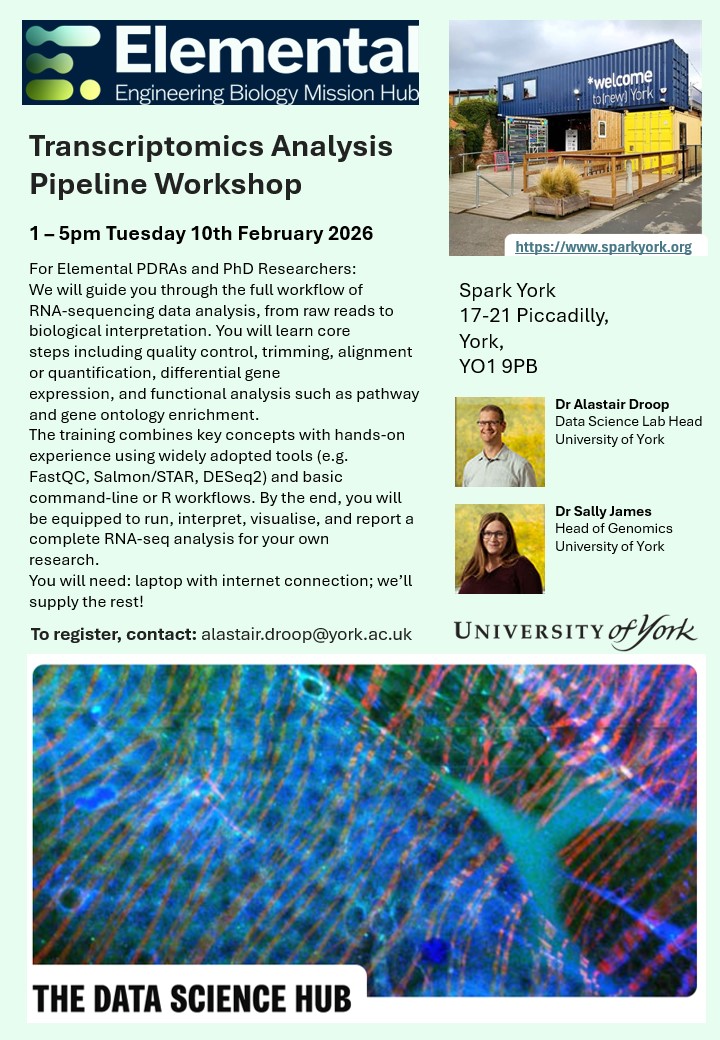
Date: Tuesday 10 February 2026
Time: 1:00–5:00 pm
Location: Spark York, 17–21 Piccadilly, York, YO1 9PB 

About the Workshop 

Join us for a hands-on introduction to RNA-sequencing data analysis, designed specifically for Elemental PDRAs and PhD researchers (but open to others, see costs below).
We’ll walk you through the complete RNA-seq workflow, from raw reads to biological interpretation. Topics include: 

  • Quality control and trimming 
  • Alignment or quantification 
  • Differential gene expression analysis 
  • Functional analysis (pathway and GO enrichment) 

You’ll work directly with widely used tools such as FastQC, Salmon/STAR, and DESeq2, using simple command-line and R-based workflows. By the end of the session, you’ll be confident in running, interpreting, visualising, and reporting a full RNA-seq analysis for your own research. 

What You Need 

  • A laptop with an internet connection 
  • All software and data will be provided 

Costs 

  • Elemental researchers: Free
  • Non-elemental researchers: £100 attendance fee 

Register: To register, please email alastair.droop@york.ac.uk. 

We are pleased to invite you to a one-day Finance Essentials workshop designed specifically for researchers interested in understanding how research can translate into real-world impact, including commercial opportunities.
  • Time: 10:00 am – 5:00 pm
  • Location: Natural History Museum, London
This workshop will give you a practical overview of the financial aspects of turning ideas into viable businesses, without assuming prior business experience. It’s a great opportunity to:
  • Understand the basics of business finance – how funding works and how companies grow.
  • Gain insight into investors’ perspectives – what different types of investors look for in a project.
  • See how value is created in a business – how decisions made today can impact long-term success.
  • Learn the fundamentals of accounting in plain language – key financial concepts explained simply.
  • Explore how projects are evaluated – and how potential opportunities are assessed by decision-makers.
In addition to the in-person session, participants will also receive access to online learning modules.
Whether you’re curious about the commercial potential of your research or simply want to understand how businesses make financial decisions, this workshop will give you a clear, practical foundation that could be useful now or in the future.
Spaces are limited, so we encourage you to register early to secure your place.

The Geomicrobiology Network is hosting its annual Research in Progress Meeting, taking place at the Natural History Museum, London, on Tuesday, October 7th, and Wednesday, October 8th, 2025.

This meeting provides a vibrant platform for researchers across the broad spectrum of geomicrobiology to share their latest work, network with colleagues, and foster collaborations. The network especially encourages early career researchers to participate and showcase their research in this supportive environment.

Event Highlights

  • Date: October 7-8, 2025
  • Location: Natural History Museum, London
  • Format: In-person and online presentations
  • Participation: Open to all geomicrobiology-related disciplines, including biogeochemistry, biomineralization, microbial ecology, astrobiology, and more.

Call for Abstracts
The network welcomes submissions of posters and talks from researchers at all career stages. Abstract submission opens on June 16th and closes on August 15th, 2025.

Find out more about this event here: Geomicrobiology Network – Mineralogical Society of the UK and Ireland.

Critical Minerals and Materials (CM) are essential to a wide range of advanced technologies and play a key role in delivering the UK’s economic, environmental, and Net Zero goals

The £15m Circular Critical Materials Supply Chains (CLIMATES) Programme was established in early 2023 to support the growth of the Rare Earth Element (REE) and Rare Earth Permanent Magnet (REPM) supply chains in the UK, through targeted innovation funding and associated activities.

Following the updated Criticality Assessment in late 2024 that expanded the list of Critical Minerals to 34, in 2025 the CLIMATES programme is exploring the opportunities in the wider Critical Materials space.

This Critical Materials Innovation Café webinar series is bringing together the UK’s Critical Materials community—facilitating discussion, sharing insights, and helping shape the future direction of the CLIMATES programme.

Why attend?

  • Learn about innovation and funding opportunities across REEs, REPMs and the wider list of CMs
  • Inform the future direction of the CLIMATES programme
  • Connect with like-minded innovators and potential collaborators in the CM space

Dates:

  • 13th August 11am-noon: “Innovation Opportunities in the REE Value Chain”
  • 10th September 11am-noon: “Beyond REEs: The 2024 UK CM list”
  • 8th October 11am-noon: “Innovation Opportunities for CMs in key UK industries”

Hosted by UKRI Business Connect, you can read more and register here.

UK Research and Innovation (UKRI) hosted a webinar on 4 July 2025, highlighting the work of the ELEMENTAL Mission Hub. This event was part of a series featuring the six UKRI Engineering Biology Mission Hubs. The webinar was free to attend and open to researchers, innovators, businesses, investors, and policymakers.

The ELEMENTAL Mission Hub, led by the University of Kent in collaboration with institutions including the Quadram Institute and University College London, focused on developing sustainable solutions for the recovery and processing of metals. By employing engineering biology techniques, the hub aimed to address challenges related to metal waste and scarcity, contributing to a circular economy.

During the webinar, attendees learned about the hub’s objectives, ongoing research activities, and opportunities for engagement. A Q&A session followed, allowing participants to interact with the Mission Hub team. For more information, visit the UKRI events page.

Video recording can be viewed here.

This webinar is part of a series taking place over 2025. Each webinar will feature members from one of the six UK Research and Innovation Engineering Biology Mission Hub teams.


Registration is now open for the BBSRC Sparking Innovation Conference taking place in Leeds, 30 April-1 May 2025. Further information and application form can be found here.

The National Measurement Laboratory is offering free online training to Elemental Hub PDRAs and Co-Is.

They have secured BBSRC funding to develop and run a metrology and standardisation course specifically for the Engineering Biology Mission Awards and this will be offered across all the Hubs and awards.

Structure: The initial stage of the training would be online with one of the NML team, typically in a group of ~20 people comprised of members of all the EB Mission Awards (likely to be around 8 or 9 groups of 20). It is envisaged that this training  will take around 6 hours in total but delivered over 2-2.5 days (possibly a morning/afternoon or lunch and learn type sessions). The training will be interactive with the use of polls/chat function and would be recorded with the slides used being made available to attendees afterwards. This is likely to start in February/March 2025 and is **free** to PDRA’s and Co-Is on the Elemental Hub.

For those interested in progressing to advanced training, this will be delivered in person from 2026 and likely to be funded through our seedcorn award.

Content:  Prior to commencing training, attendees will be sent a survey from NML to gauge level of prior knowledge and areas of interest, so that the content can be made relevant. A link to some of the NML existing online courses can be found here if you would like to get an idea of how these look.

The initial stage of training is designed to support TRLs 1-4; the advanced training is aimed at TRLs 5-7 (support for commercialisation), then support via direct discussions with NML scientists for TRL8-9 (see slide 6).

If you are interested in registering for this training, please email elementalmetalhub@kent.ac.uk by week ending 17 January 2025.

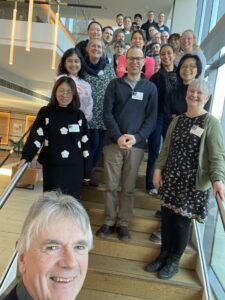
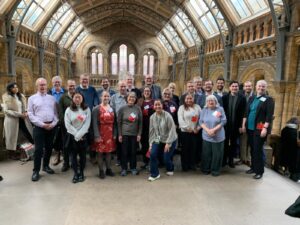
The BBSRC ELEMENTAL Engineering Biology Mission Hub held its first annual meeting in Manchester on 15-16 January 2025. Our Hub is focused on developing efficient bioengineering solutions to create a sustainable, circular economy through the recovery and processing of metals from various sources and waste streams. Our PDRAs and Co-Investigators presented their progress across our six research themes – Bioleaching, Biorecovery, Bioprocessing & Industrial Biotechnology, Biosensing, Bioremediation, and the Circular Economy of Metals. Researchers will regularly post updates on their progress to our HUB Research Blog link. Also joining us were members of our Strategic Advisory Board and our BBSRC Engineering Biology Senior Portfolio Manager.We were excited to discuss as a group how to tackle the challenges of implementing bioengineering solutions at scale as we fulfil the Engineering Biology Mission Hub goal of translating research discoveries into commercial benefit across different sectors of UK society.  

We cordially invite you to join us in an interactive workshop on 20 Jan on Biotechnology for metals at the University of Surrey to discuss the successes and challenges learnt from this, brainstorm the next big ideas and develop collaboration. Speakers and participants are expected from the groups undertaking BBSRC-funded biotech for metal circular economy projects. 

Researchers from the US Critical Materials Innovation Hub, together with the UK Science and Innovation Network, academic, Department of Energy and industrial colleagues from the US, visited the UK 2-6 December 2024 for workshops with Elemental Hub members to discuss mutual research interests and potential collaborations.

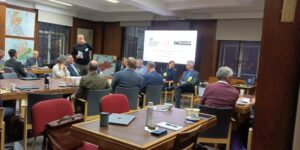
A visit to Prof. Jon Lloyd in Manchester took place 3-4 December. A workshop with Elemental Hub members, academic guests and representatives from BBSRC, Innovate UK and DSIT took place at the Natural History Museum in London on 5-6 December.

UKUS_EngBio-CM-flyer

Slides from presentations on 5 December may be seen here. Slides from presentations on 6 December may be seen here.

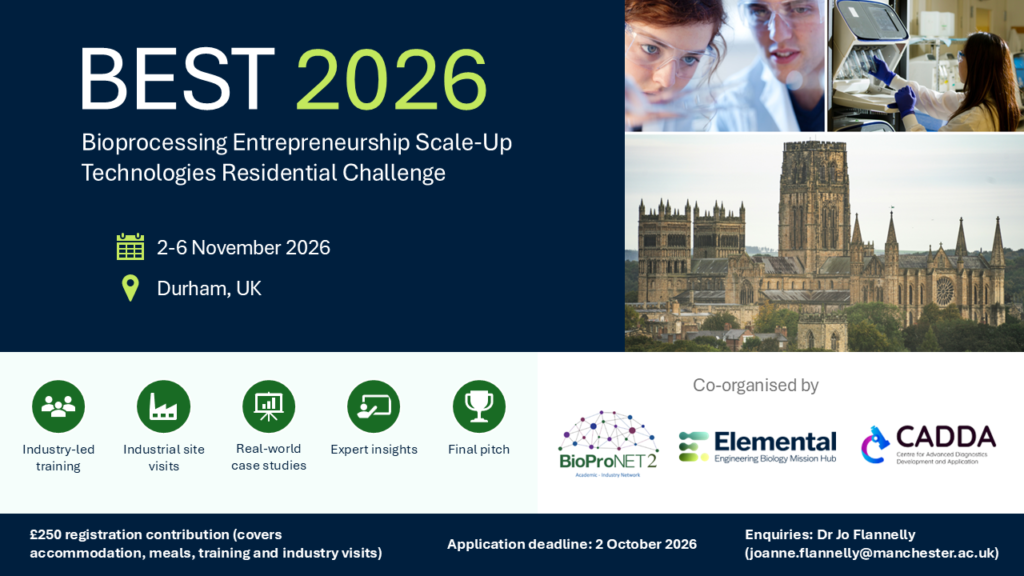
Do you want to find out how your career might develop working for industry, the differences between industrial- and academic-driven research and how the industrial environment matches your career ambitions?

Are you interested? If you are (a) an Early Career Researcher (normally at year 3 or later of PhD training or on your first post-doctoral position in an academic environment but potentially in the early stages of an industrial career) and (b) working in the area of bioprocessing of biopharmaceuticals or novel biological therapeutics then this could be an ideal opportunity for you. It is likely that you are already working on a project that has an industrial collaborator but this is not essential.

The week-long residential programme is co-organised by BioProNET2 and E3B (a BBSRC Network in Industrial Biotechnology and Bioenergy, BBSRC NIBB) and is possible due to funding from the BBSRC. Participation will be limited to 18 attendees. Your accommodation, meals and all training activities will be provided to eligible applicants.  Each participant will be asked to make a £150 non-returnable contribution for registration once their acceptance of a place is confirmed.

Formal REGISTRATION is now open and you can make informal enquiries to Dr Jo Flannelly (joanne.flannelly@manchester.ac.uk).

Sessions form part of an integrated package that culminate in a Dragons Den-type pitch for establishment of a novel business concept:

  • Talks on molecular design for development, manufacture and delivery of biological therapeutics and the societal/economic consideration of novel therapeutics  
  • Tutoring on the tools for self-awareness in working with others, career development and the entrepreneurial process  
  • Industrial site visits (CPI, FUJIFILM Diosynth Biotechnologies, Iksuda Therapeutics) coupled with presentations from, and discussions with, industrial practitioners.

Details may be found here

Professor Martin Warren introduced ELEMENTAL Metal Hub to the meeting. EngBio slides