Dan Ting Chen, Amitava Roy, Anna Bogush, and Julia A. Stegemann.
Summary
Our study explores how valuable metals like chromium, zinc, copper, and lead are stored in industrial waste, i.e., filter cakes from metal finishing wastewater treatment. Using advanced synchrotron radiation technique, i.e., X-ray Absorption Spectroscopy (XAS), it reveals which metals are safely locked in place and which can be released under certain conditions. This knowledge helps scientists design smarter biological and chemical methods to recover useful metals while protecting the environment. Ultimately, it supports more sustainable ways to turn waste into valuable resources—at the heart of ELEMENTAL Hub’s mission.
Graphical Abstract

Abstract
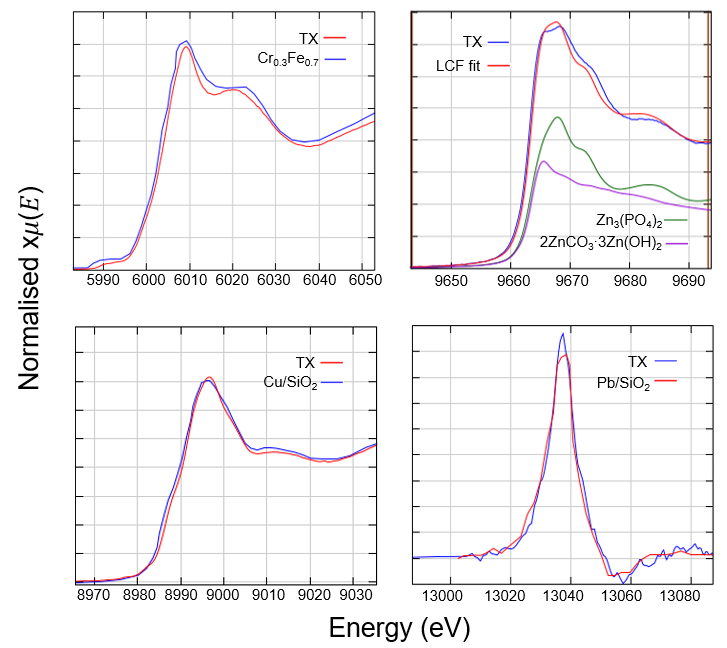
The speciation of Cr, Zn, Cu and Pb in two metal finishing filter cakes (TX and ST) was investigated by X-ray absorption spectroscopy (XAS) complemented by X-ray fluorescence (XRF) and X-ray diffraction (XRD). XRF showed that concentrations of Cr, Zn, Cu and Pb were 1.4%, 0.19%, 0.20% and 0.01%, respectively, in TX, and 12.6%, 3.3%, 1.3% and 0.21% in ST. No crystalline phases were detected in TX by XRD whereas ST was dominated by calcite. Cr and Fe K edge XAS showed Cr to be trivalent and octahedrally coordinated, co-precipitated with Fe as CrxFe1-x-(oxy)hydroxides in both filter cakes. Zn, P and Ca K edge XAS showed that 2ZnCO3∙3Zn(OH)2 and Zn3(PO4)2 were the dominant zinc-containing phases, with combined tetrahedral and octahedral coordination; Zn phases were slightly more crystalline in TX than ST. Pb L3 edge X-ray absorption near edge spectroscopy (XANES) found that Pb was likely adsorbed on amorphous SiO2. Cu, Si and S K edge XAS showed that all Cu was divalent, and the dominant copper phases were found to be Cu2Cl(OH)3, Cu(OH)2 and CuSO4·5H2O for ST, whereas Cu appeared to adsorb to amorphous SiO2 for TX, which contained much less Pb. Cr is thus immobilized in the filter cakes in a phase with low solubility at environmentally feasible pH values, whereas Zn, Cu and Pb could be released when the pH decreases below 8 or above 11. These findings are significant for the development of waste management regulations and/or metal recovery methods (e.g., hydro/pyrometallurgy).