**©Sadhukhan et al. 2026. Green Chemistry, submitted. “PHA Biocomposites from Lignocellulose: Scalability and Sustainability Analyses through Dynamic Simulation, LCA, and TEA”
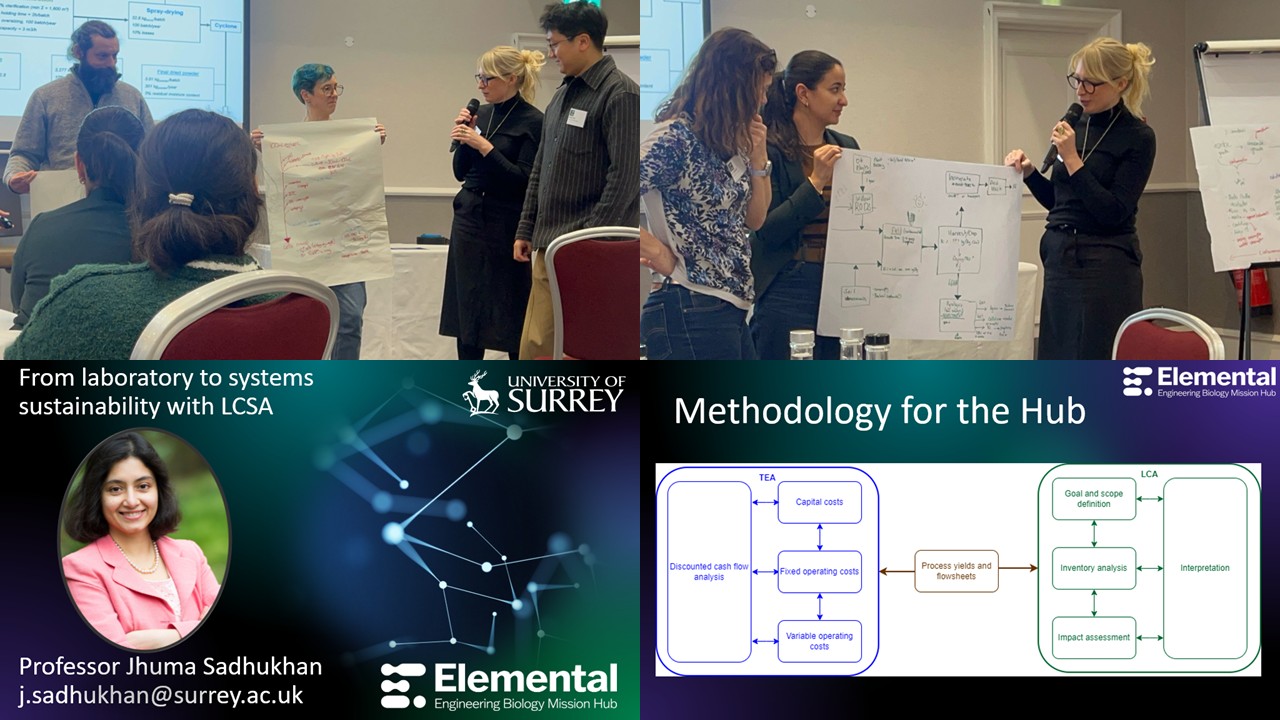
At the recent Elemental Annual Meeting in York, part of the Day 2 programme brought participants together for a focused workshop on scaling processes and applying Life Cycle Assessment (LCA) within the context of a circular bio‑economy.
The session, titled “LCA Scale Up and the Circular Economy,” was delivered by members of Work Package 6 (Circular Economy and Practical Implementation), specifically Julia Stegemann, Brenda Parker, Jhuma Sadhukhan, and Danting Chen, and centred on connecting sustainability assessment with real‑world process design.
Workshop Objectives
The workshop aimed to equip researchers and stakeholders with practical tools and insights to:
- Identify key components of envisioned scaled processes, including inputs, outputs, and energy/chemical flows.
- Visualise system interactions in preparation for developing system diagrams required for LCA and scale‑up planning.
- Highlight strategies for incorporating sustainability and scalability considerations early in the research and process design pipeline.
Through facilitated group work and discussion, participants explored how to define and map process boundaries, consider interactions across unit operations, and frame systematic LCA thinking as part of scaling experimental technologies toward industrial relevance.
Why LCA Matters for Elemental Research
Life Cycle Assessment provides a quantitative framework to evaluate environmental impacts across the full lifespan of a technology, from raw materials to end‑of‑life. By integrating LCA at early stages, researchers within the Elemental Hub can better anticipate sustainability trade‑offs, optimise design decisions, and align innovations with circular‑economy goals.
This workshop contributed directly to expanding participants’ capabilities to:
- Combine technical design with environmental assessment,
- Visualise complex systems in a structured way, and
- Prepare for robust sustainability evaluations as technologies mature.
The session underscored the importance of embedding sustainability thinking, particularly LCA and scale‑up considerations, in research pathways that aim to deliver real‑world impact.