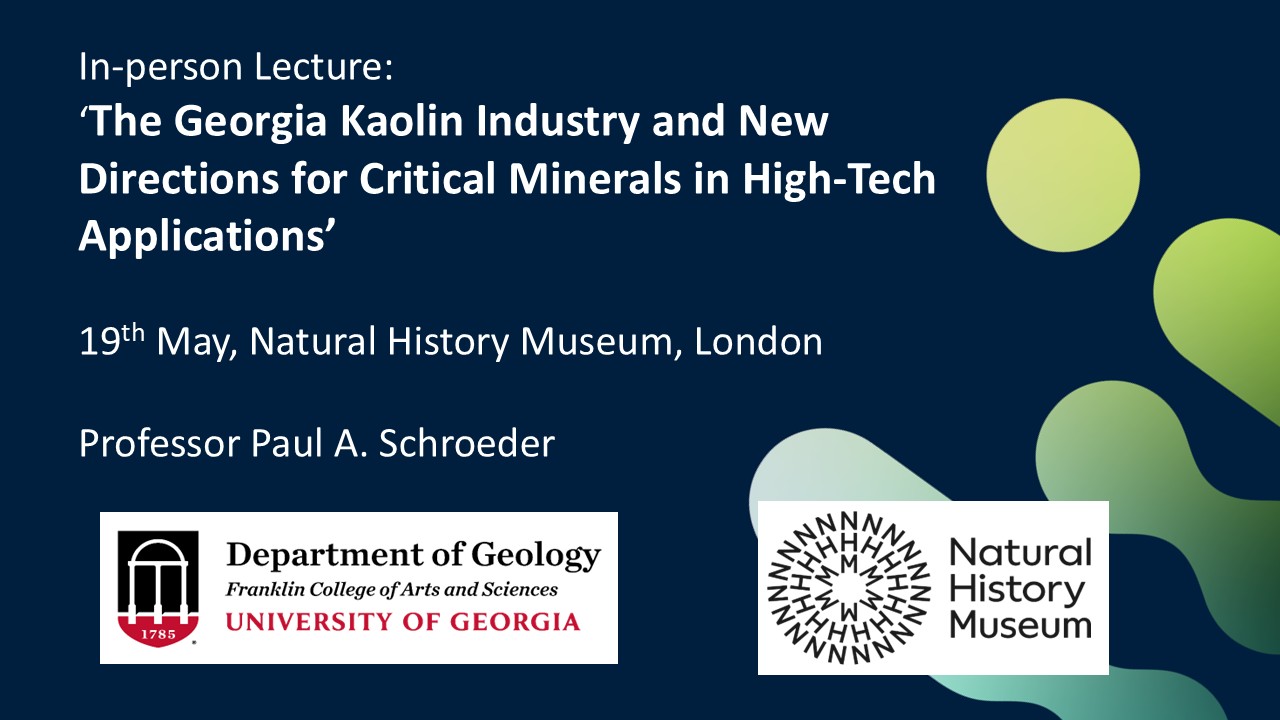
Join us at the Natural History Museum for a lecture by Professor Paul A. Schroeder exploring the history and global significance of the Georgia kaolin industry and its links to the development of high-tech materials.
- 19th May 10-11
- Natural History Museum, London
- Registration: Lecture by Professor Paul A. Schroeder- Natural History Museum, London – Fill in form
Drawing on decades of research, he will discuss how kaolin mining may also offer new opportunities to recover rare earth elements, critical minerals essential for modern technologies. This talk will highlight emerging pathways to strengthen sustainable supply chains for advanced materials.
Bios: Professor Paul A. Schroeder.
https://geology.uga.edu/directory/people/paul-schroeder
Professor Paul A. Schroeder is a clay scientist with nearly 45 years of research spanning crystal chemistry and mineral reactions on the Earth’s surface and below. His work extends from laboratory spectroscopy and isotope geochemistry to field studies of soil formation, hydrothermal alteration in volcanoes, kaolin clays, and planetary materials, including Martian regolith. He has authored more than 70 refereed journal articles, 14 book chapters, and the textbook Clays in the Critical Zone (Cambridge University Press), including a highly cited Science paper on nanomaterials and Earth systems. A former president of the Clay Minerals Society, Professor Schroeder has played a leading role in advancing critical minerals research in Georgia and internationally while mentoring students for over three decades at the University of Georgia.
Abstract Title: The Georgia Kaolin Industry and New Directions for Critical Minerals in High-Tech Applications
China clay has been used for more than 2,000 years to produce porcelain, a material that some consider the first high-tech, human-made product. This resource, also known as kaolin, takes its name from Gaoling (“high ridge”) near Jingdezhen in China. There, it was transformed into prized ceramics described as “thin as paper, bright as a mirror, and white as jade.” For centuries, trade along the Silk Road brought prosperity to the West and introduced fine porcelain dinnerware and sculpted objects that rang with musical tones when struck. European fascination with these materials led William Cookworthy to discover kaolin deposits in Cornwall, United Kingdom, enabling domestic porcelain production. Earlier, however, Josiah Wedgwood had imported consignments of kaolin from Georgia, USA, to the UK, helping drive advances in kiln technology and establishing the distinguished legacy of Wedgwood china.
Over the past century, kaolin mining has expanded far beyond porcelain production. Today, kaolin is an essential ingredient in numerous high-tech applications, including paper coatings, ceramics, pigments, plastics, rubber, and pharmaceuticals. The global kaolin market is now valued at nearly $5 billion annually, with Georgia accounting for approximately $1 billion of that total.
Looking ahead, the demand for advanced materials with specialized thermal and electrical properties increasingly depends on rare earth elements (REEs). REEs are classified as critical minerals—elements deemed essential for economic stability and national security. Opportunities may exist to co-produce REEs from existing mining operations, commonly referred to as brownfields. Kaolin brownfields in Georgia and the United Kingdom may provide such opportunities through the recovery of REEs from waste ponds, overburden, and reject streams generated during kaolin beneficiation. Preliminary assessments suggest that economically meaningful concentrations occur within several kaolin processing streams.
Advancing the technology readiness levels required to extract and refine REEs for high-tech supply chains remains challenging. Key considerations include energy demand, environmental sustainability, workforce development, and engagement with stakeholders affected by the full lifecycle of resource extraction and processing.
Registration: Lecture by Professor Paul A. Schroeder- Natural History Museum, London – Fill in form